Liquid Compost Extract Manufacturing: Process Control Issues Production Managers Watch
Liquid compost extract can look deceptively simple from outside the plant: compost, water, agitation, separation, stabilization, pack-out. On the floor, it is a living, variable, solids-bearing bioprocess with narrow commercial tolerances.
For a biofertilizer manufacturer, the challenge is not only making a biologically active extract. It is making a product that behaves consistently across feedstock lots, tanks, shifts, seasons, filling lines, and customer storage conditions.
That is where process control becomes a margin issue. Extraction behavior affects throughput. Suspended solids affect downstream handling. Organism viability affects product claims and field performance. Odor, foam, viscosity, and sediment affect customer confidence. Enzyme selection can support conversion and handling, but only when matched to the compost matrix, microbial consortium, and plant operating window.
Enzymesportal works as an enzyme supplier for biofertilizer manufacturing teams that need practical support around substrate conversion, extraction consistency, and production reliability—not generic enzyme recommendations detached from the realities of a live biofertilizer line.
Why liquid compost extract is hard to standardize
Compost is not a uniform raw material. Even when the supplier and recipe are consistent, the actual process inputs can shift in ways that matter:
- Feedstock origin and maturity
- Lignocellulosic content and residual fiber structure
- Humic fraction behavior
- Mineral load and ash contribution
- Moisture history before extraction
- Natural microbial background
- Particle size distribution after screening or milling
- Storage age and temperature exposure
Those variables influence how readily soluble nutrients, microbial metabolites, and fine organic fractions move into the liquid phase. They also influence how much insoluble material remains suspended, how quickly sediment forms, and how the extract behaves during pumping, filtration, blending, and filling.
A production manager usually sees these shifts as plant-floor symptoms: longer extraction times, unstable foam, higher sludge load, blocked strainers, inconsistent color, odor drift, or tanks that do not settle the same way as the previous batch.
The process-control points that deserve attention
1. Compost maturity before extraction
Under-mature compost can increase odor risk, gas formation, and biological instability after packaging. Over-processed or harshly dried compost may extract poorly and contribute less desirable biology.
A practical incoming-control program should define what the plant accepts, rejects, or segregates. Production teams often benefit from routing different compost lots into different product formats instead of forcing every lot through the same extraction recipe.
2. Water quality and mineral interaction
Water is not a passive carrier. Hardness, residual disinfectants, salinity, and pH behavior can change extraction performance and organism stress.
For liquid compost extract, water quality affects:
- Wetting of organic particles
- Release of soluble fractions
- Foam character
- Tank-wall residues
- Microbial viability during processing
- Compatibility with later additives
If a plant sees unexplained batch drift, water should be investigated alongside compost—not after every other variable has been exhausted.
3. Extraction intensity
More agitation is not always better. Higher shear can improve contact between compost and water, but excessive mechanical intensity can increase fine solids, heat, foam, and stress on sensitive organisms.
Production teams should evaluate extraction as a balance between conversion, handling, and viability. The best endpoint is not simply the darkest liquid or the most aggressive extraction profile. It is the profile that gives repeatable product quality and acceptable downstream behavior.
4. Enzyme-assisted conversion
Enzymes can support liquid compost extract manufacturing by helping open plant-derived material, improving release of soluble organic fractions, reducing viscosity drivers, and supporting more predictable extraction from variable compost matrices.
The fit depends on the compost source and the desired product outcome. A blend aimed at fiber loosening may not be the same as a blend used to manage viscosity or improve soluble fraction release. Compatibility with the microbial consortium is also essential.
Enzymesportal evaluates enzyme recommendations around production use cases such as:
- Improving substrate conversion without over-processing the extract
- Supporting batch-to-batch extraction consistency
- Reducing troublesome suspended organic load
- Improving pumpability and mixing behavior
- Protecting organism viability within the operating window
- Avoiding enzyme systems that conflict with formulation goals
For manufacturers comparing an enzyme supplier for biofertilizer manufacturing, the key question is not “which enzyme is strongest?” The better question is “which enzyme approach produces a more controllable batch in our process?”
Downstream handling problems that start upstream
Sediment and suspended solids
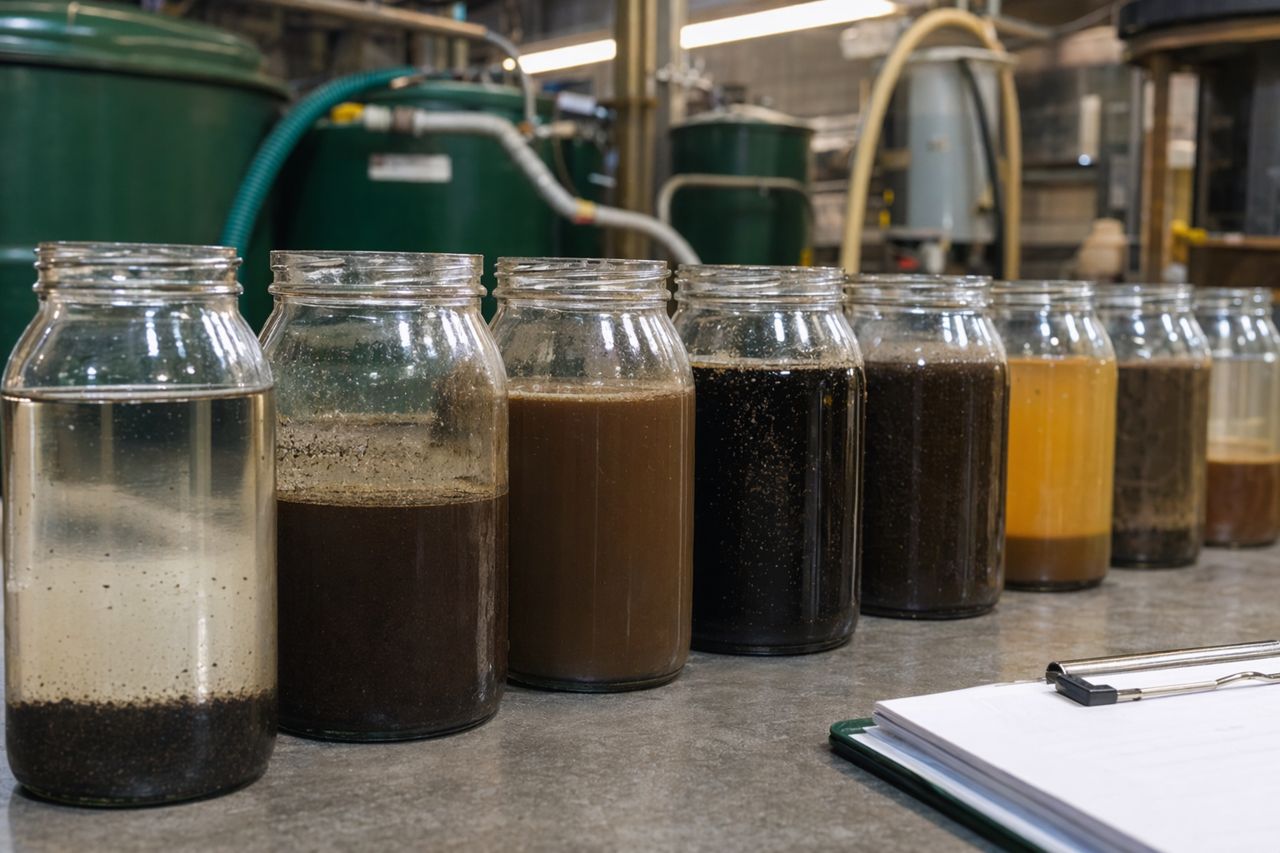
Sediment is not just a cosmetic issue. It affects dosing accuracy, filling consistency, label perception, and customer use in fertigation or spray systems.
High suspended solids can create issues at:
- Transfer pumps
- Inline screens
- Holding tanks
- Homogenization steps
- Filling nozzles
- Customer application equipment
A controlled process should distinguish between beneficial colloidal material and coarse, unstable solids that create complaints. Enzyme-assisted processing may help reduce certain structural contributors, but it should be validated against the full line, not only the extraction tank.
Viscosity and pump behavior
Liquid compost extracts can vary in viscosity depending on feedstock composition, soluble organic load, fine particles, microbial exudates, and added stabilizers. Viscosity drift often shows up as slower transfers, inconsistent fill weights, poor mixing with downstream inputs, or higher residue in tanks and hoses.
Controlling viscosity is rarely a single-variable fix. It can involve compost selection, water management, mixing profile, enzyme treatment, settling strategy, and formulation design.
Foam and gas formation
Foam can reduce tank capacity, interfere with level sensing, complicate filling, and create sanitation concerns. Gas formation after packaging is a separate but related risk that can damage containers and undermine product trust.
Foam and gas should be tracked by batch history, compost lot, temperature exposure, extraction recipe, and formulation changes. Enzyme changes should be introduced with attention to biological response and packaging stability.
Organism viability is a process outcome, not a final inspection step
Liquid compost extract manufacturing sits at the intersection of physical extraction and biological preservation. Organism viability is affected throughout the process:
- Incoming compost condition
- Water quality
- Temperature exposure
- Shear environment
- Residence time
- Oxygen profile
- Additive compatibility
- Packaging conditions
- Storage temperature after filling
A process that extracts aggressively but damages the biological profile may create a product that looks strong in the tank and disappoints later. The production target should be a stable operating window that supports both conversion and viable biology.
This is one reason enzyme selection should not be isolated from the organisms in the product. The enzyme system, timing of addition, contact period, and formulation context all matter.
What production managers should monitor by batch
A practical batch record for liquid compost extract does not need to be complicated, but it should connect raw material variation with plant-floor behavior and finished product outcomes.
Useful production observations include:
- Compost lot identity and storage condition
- Visual maturity and odor notes
- Water source and pretreatment status
- Mixing sequence and extraction time
- Temperature trend during processing
- Foam behavior
- Settling behavior after hold
- Transfer and filtration performance
- Residue after tank discharge
- Fill-line behavior
- Packaging appearance after hold
- Field complaints or customer handling feedback by lot
The goal is not paperwork for its own sake. The goal is pattern recognition. Once the plant can see which inputs create which handling problems, enzyme and process adjustments become much more precise.
Choosing an enzyme supplier for biofertilizer manufacturing
Biofertilizer plants do not need an enzyme supplier that only ships catalog products. They need a partner who understands that a living agricultural input is not the same as a detergent, starch, pulp, or beverage process.
When evaluating an enzyme supplier, production and technical teams should look for:
- Experience with biologically active agricultural formulations
- Ability to discuss compost variability and carrier systems
- Compatibility thinking around microbial consortia
- Support for pilot trials before plant-wide adoption
- Practical documentation for production, QA, and procurement teams
- Supply reliability for seasonal manufacturing cycles
- Willingness to adapt recommendations to actual plant constraints
Enzymesportal supports manufacturers with enzyme options designed to fit controlled bioprocessing, downstream handling, and viable product manufacturing. The aim is not to complicate the line. The aim is to make the line more predictable.
Where enzyme trials should start
The best trials usually begin with one defined production problem, not a broad request to “improve extraction.” Examples include:
- A compost lot that produces excessive sediment
- A product format with unstable viscosity
- A line that sees slow transfer after extraction
- A formulation that needs better soluble fraction release
- A batch family where odor or gas risk increases after storage
- A process that changes behavior when compost source shifts
Start with a clear control batch, a defined success measure, and a downstream review. If the extract looks better in the tank but causes a filling issue later, the trial has not succeeded. If organism viability is compromised, the enzyme approach needs to be changed.
Enzymesportal’s practical position
Liquid compost extract manufacturing rewards discipline. The plants that scale well are usually the ones that treat the process as both biological and industrial: living enough to require care, controlled enough to require repeatability.
Enzymesportal helps biofertilizer manufacturers evaluate enzyme use where it matters most: substrate conversion, process consistency, downstream handling, and organism-compatible production.
If your team is reviewing enzyme-assisted extraction, troubleshooting batch drift, or qualifying a more reliable enzyme supplier for biofertilizer manufacturing, use the on-site request a quote form and share your compost source, process goal, and current handling issue. We will help you identify a practical next step.